7 steps you need to take when hiring a new employee
You found the perfect candidate. They aced three rounds of interviews, you agreed on the salary, the start date is two weeks away. Everyone is happy.
And then the chaos starts.
Payroll registration — when exactly? Health insurance — is that automatic? ID document — do you need a copy or the original? Workplace safety training — who organises that? Medical exam — for every role or only some? Tax form — what even is that?
Every time you hire someone new, you walk through the same maze of steps. Skip one — you risk a fine or a problem during an inspection. And if you're hiring a foreign national, the procedure is even more layered.
This post is your guide. All 7 steps, in order, with what happens if you skip any of them.
1. Employment contract — sign it BEFORE the first day of work
This sounds obvious, but the number of companies that let an employee start working without a signed contract is surprisingly high. Most labour codes are clear: the contract has to be signed before the first working day.
What the contract must contain:
- Job title and description of duties
- Contract duration (open-ended or fixed-term, with end date)
- Place of work
- Salary (gross amount)
- Working hours (full-time, part-time, shift work)
- Annual leave entitlement
- Notice period
Two copies
One for the employee, one for you. You keep it for the entire duration of the employment + the retention period required by your jurisdiction after the contract ends.
What happens if you don't have a contract
Labour inspectors generally treat work without a contract as undeclared work. Penalties are serious — for the company and for the responsible person. And if a dispute with the employee arises, without a written contract you have nothing to prove the agreed terms.
Kloki tip: The employment contract is signed once and kept for years. In Kloki, you can store the signed contract digitally in the employee's personnel file — always available, never lost.
2. Register the employee with payroll and social insurance — before they start working
Deadline: at the latest before the employee starts working. In practice that means the day before or the morning of — but never after they've already started doing the job.
How registration works
Most countries now run payroll and social-insurance registration through an electronic portal. Paper forms are mostly history.
Information you'll typically need:
- Employee tax/identification number
- Full name
- Start date
- Contract type (open-ended / fixed-term)
- Working hours (full-time / part-time, number of hours)
- Job classification code (where applicable)
Health insurance
In many systems, statutory health coverage activates automatically when payroll registration is filed — no separate step required. Check the rules in your jurisdiction.
What happens if you're late
An employee who starts working without being registered = undeclared work = inspection = serious fine. This is one of the most common violations inspectors look for and penalise. Don't risk it.
3. Collect the required documents
Before or on the first working day, collect from the employee:
- Copy of an ID document — for identification and the personnel file
- Tax/identification number — for payroll registration and tax purposes
- Proof of qualifications — for roles that require a specific certification
- Bank account details — for salary payments (most jurisdictions require salaries to be paid by bank transfer)
- Tax allowance / dependants form — for the personal tax allowance and any deductions
Where to keep the documents
Most employment laws require you to maintain a personnel file for each employee. That can be a physical folder in a cabinet — or a digital personnel file where everything sits in one searchable place.
Common mistake: You collect the ID and tax number but forget the dependants form. Result: wrong tax allowance, wrong net pay, unhappy employee, mess at year-end reconciliation.
4. Workplace health & safety — mandatory for EVERY employee
It doesn't matter whether your employee works in an office, on a building site, or from home. Every employee must complete safety training before they start working independently. This is true in essentially every developed labour-law regime.
What you need:
- Risk assessment for the role — a document describing potential hazards
- Employee training — theoretical and/or practical, depending on the role
- Training record — signed by the employee and the trainer
- Certificate of completion — kept in the personnel file
Who organises it?
Below a certain headcount and outside high-risk sectors, the employer can usually run safety duties in-house. Otherwise — you'll need a qualified safety officer (employed or external).
What happens if you skip it
Safety inspectors verify training records — and fine employers without proper documentation. If an employee is injured without documented training, the consequences are serious — both legally and financially.
5. Medical exam — for certain roles
Not every role is the same. For some, a pre-employment medical exam is mandatory before the first day of work:
- Roles with special working conditions (noise, chemicals, working at height)
- Night work
- Work involving children and minors
- Professional drivers
In practice
For most office roles, a medical exam is not legally required — but many employers organise one anyway as part of onboarding. If you're not sure whether you need one for a specific role, check the risk assessment or consult a safety officer.
Timing
Pre-employment medical exams must be done before work starts on a role with special conditions. Not afterwards, not "we'll sort it next week."
6. Tax form and personal allowance
Most income-tax systems give every employee a personal tax allowance — an amount on which no income tax is paid. The size of that allowance often depends on dependants (children, spouse, parents).
What you need from the employee:
- Dependants declaration — the employee fills in the form
- Tax IDs of dependants — for the tax authority
- Residence information — for any local tax surcharges
Tax form processing
Based on the employee's declaration, the data flows into payroll. This is usually handled by your accountant — but you have to make sure the employee actually delivers the information.
Common mistake: The employee doesn't submit the dependants form → only the minimum personal allowance is applied → their net pay is lower than expected → they call you on a Friday afternoon asking "why is my salary smaller than we agreed?"
7. Digital personnel file — everything in one place
Every step above generates documentation. Contract, certificates, ID copy, tax number, declarations, training records. For one employee that's a stack of paper. For twenty employees — that's a cabinet full of folders.
And every time you hire someone new, you have to remember the same sequence of steps. Have you collected the ID? Has training been completed? Has the dependants form arrived?
How Kloki helps with organisation
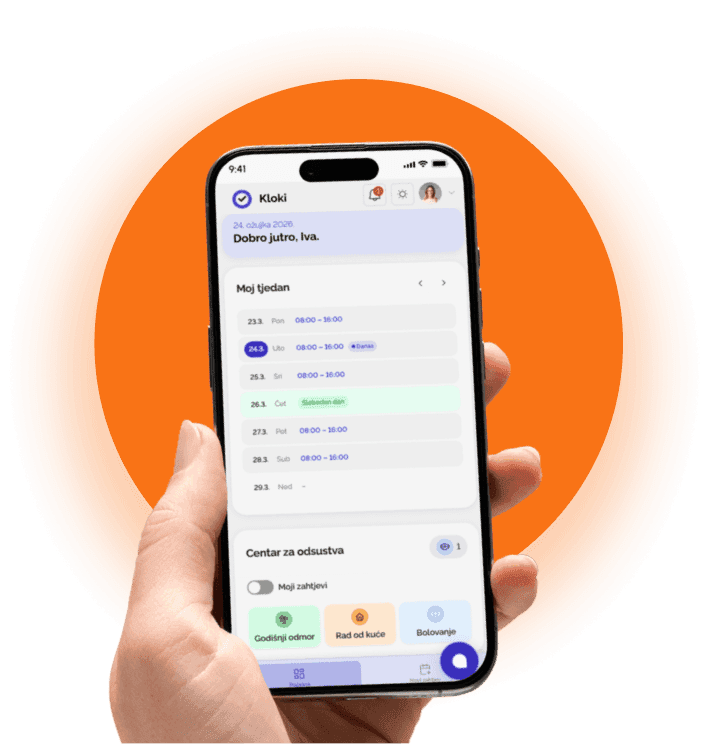
In Kloki, each employee has a digital personnel file — one place to keep:
- The employment contract (stored digitally)
- A copy of the ID document
- Workplace-safety training certificates
- Medical exam certificates
- Any other documents tied to the employment relationship
When you hire someone new, you have a clear view of what's been collected and what's still missing. When a medical exam or safety training certificate is about to expire — Kloki reminds you.
And when an inspector asks for an employee's documentation — it's all in one place, available in seconds. Not in a cabinet nobody has opened since last year.
Important: Kloki does not file payroll or social-insurance registrations — you do those through your country's official portal. But everything else — document organisation, digital storage, personnel-file overview — Kloki has covered.
Bonus: hiring a foreign national
If you're hiring someone who is not a national of the country where you operate, the procedure depends on where they're coming from:
EU/EEA nationals (in EU member states)
Same procedure as for local nationals. No work permit, no extra paperwork. Free movement of workers within the EU.
Third-country nationals
This is where things get more complex:
- A work permit or combined residence-and-work permit is usually required
- Additional documents: passport copy, residence permit
- The process typically runs through the immigration authority
- Lead times are longer — plan ahead
Note: Hiring third-country nationals is a complex topic with many country-specific details. For specifics, consult a lawyer or your local immigration authority. This post covers the basics, but every situation can be different.
Don't wait for an inspection to show you what you forgot
Each of these 7 steps is a legal obligation in most jurisdictions. Skip one — you risk a fine, a dispute, or a problem that's much more expensive than the time it would have taken to do it right the first time.
The good news: once you set up the system — every subsequent hire is a routine, not chaos. Digital personnel file, checklist of steps, documents in one place.
If you want to see how Kloki handles the rest of HR after the hire — from PTO disputes to digital signatures on every document — each of those posts shows how to digitise a specific part of HR admin.
Try Kloki for free — and hire your next employee without wondering whether you forgot something.