Your employee says you approved their PTO. You don't remember. Now what?
Friday afternoon. An employee walks into your office and says: "Boss, you approved my PTO for next week. We agreed on Tuesday."
You don't remember. You check your email — nothing. WhatsApp — maybe you deleted the message. A paper request — if it ever existed, it isn't on your desk. Maybe it's in a drawer. Maybe it's in the bin.
The employee is sure they got approval. You're not sure they ever asked. And the week that's "approved" starts in three days.
This is not a hypothetical. It happens in companies with 10, 20, 50 employees — every single week. And it usually ends one of two ways: either you cave and approve PTO you didn't plan for, or a conflict festers and poisons the team for weeks.
But the real problem isn't this week. The real problem starts when a situation like this lands in front of a labour inspector, an arbitrator, or a court.
The burden of proof is on you — the employer
This is the fact most managers don't learn until they need it: under most labour codes, the employer is required to keep records of working time, leave, and HR decisions. That includes PTO requests, approvals, overtime authorizations, and any decision that affects the employment relationship.
What does that mean in practice? If a dispute arises — with a regulator or with the employee — you have to prove what happened. Not the employee. You.
If you have no record of whether the PTO was approved or not, the presumption goes in the employee's favour. If you have no record of who authorized overtime, the presumption is that you authorized it — and that you owe the premium. If you can't prove when a decision was made, the version that favours the worker is usually the one that sticks.
This isn't legal theory. It's how labour disputes actually play out in most jurisdictions.
Four situations where you need proof — and don't have it
1. PTO: "But you said I could"
The most common case. The employee claims they got verbal approval for time off. You don't recall it. The colleague who was supposedly in the room "doesn't want to get involved."
With no written trail — who requested it, when, who approved it, on which date — you have nothing to lean on. In a formal dispute, that means the employee gets to take the days, and you have to pay for them.
2. Overtime: "The team lead told me to stay late"
The employee says their team lead asked them to work overtime. The team lead says they didn't. There's no email about it. Who's right?
Without a record of the overtime authorization — who authorized it, when, and how many hours — the answer most tribunals reach is straightforward: the employer pays. The employer is the one who is supposed to have a system that tracks this.
3. Travel and expenses: "You approved the trip to the client site"
An employee submits an expense report for a trip you don't remember authorizing. Or you authorized it verbally, and now the receipts are coming in. Who said it was OK? When? Was the approval ever in writing?
4. Schedule swaps: "We swapped shifts, the manager knew"
Two employees swap shifts. One of them doesn't show up. The manager says they didn't know. The employees say they did. There's no written record of the swap.
Result: someone didn't work their shift, and you can't prove whose responsibility that was. If a regulator asks for the working-time record for that day, the gap is your problem, not the employee's.
Why email and WhatsApp aren't the answer
"But we have email!" — I hear that a lot. And I understand the logic: if everything is agreed by email, there's a trail. In practice, email and WhatsApp have four critical weaknesses as a system of record for HR decisions:
They're easy to delete. Either side can delete a message. By the time you need the proof, the message no longer exists — on either device.
There's no structure. Try finding a PTO approval for a specific employee from March of last year, in an inbox of 5,000 messages. Under what subject line? "Re: Re: Fwd: vacation"?
The timestamp isn't legally robust. An email timestamp shows when a message was sent — not that it was received, read, or accepted. WhatsApp ticks aren't legal proof.
There's no full context. An email tells you the team lead wrote "OK" on a PTO request. It doesn't tell you how many days the employee had left, whether the dates clashed with a colleague, or whether the team lead even had authority to approve it.
A system that records HR decisions has to do more than store messages. It has to know who did what, when, and in what context — and the record has to be tamper-evident.
The audit trail: what Kloki captures automatically
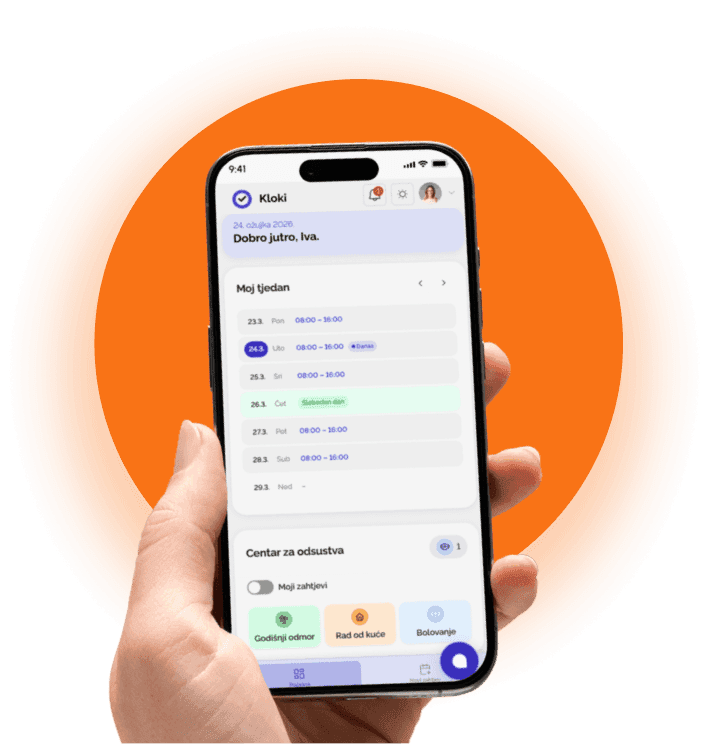
In Kloki, every action leaves a trail. Not because someone has to remember to click "log this" — the system records every step automatically.
Every decision has full history
When a manager approves a PTO request, Kloki records:
- Who submitted the request — employee name, date and time of submission
- Who approved it — manager name, date and time of approval
- What was approved — exact PTO dates
- The context — how many days the employee had left, whether there was overlap with the rest of the team
The same applies to expense approvals, overtime authorizations, schedule changes — every workflow in Kloki keeps a complete history.
Changes are visible
If something changes — for example, a manager approves PTO and then cancels it — Kloki records both actions:
- Approved: [manager name] — [date and time]
- Cancelled: [manager name] — [date and time]
There is no "someone changed something in the spreadsheet and we don't know when." Every change from the old state to the new one has a timestamp and a name attached.
Reports for an audit or a dispute — one click
When an auditor or a lawyer asks for a year's worth of PTO approval records, that's not an hour of digging through drawers. It's one click. A PDF with the full chronology: who requested what, who approved it, when, and any subsequent change.
The same goes for an employment-tribunal request. Instead of "we don't have it," the answer is: "Here it is, with timestamps."
You don't need to remember. You need a system that remembers for you.
A manager with 20 employees makes hundreds of small decisions a week. Approves PTO on the fly. Says "yes" to overtime while answering the phone. Clicks "OK" on an expense report between two meetings.
No one can remember all of those decisions. And no one should have to. But the day an employee, an auditor, or a tribunal asks — "Did you approve this?" — you need an answer. Not a memory. Proof.
Email can't deliver that. WhatsApp even less so. A spreadsheet someone updates "when they remember" — not at all.
A system with an automatic audit trail can. Every action recorded. Every entry tamper-evident. Every report available in seconds.
For a deeper look at the most common PTO approval mistakes managers make, see our piece on PTO mistakes your manager won't forgive.
Try Kloki free — and stop relying on memory when what you need is proof.