What is a digital signature and do you need one for HR documents?
A colleague tells you: "We sign everything digitally." You nod and say "yeah, sure, great" — but you don't actually know what that means. Is it a scanned image of a handwritten signature pasted into a PDF? Some app? A finger-drawn squiggle on a tablet?
And, more importantly: is any of that even legal?
If that sounds familiar, this post is for you. No technical jargon, no legalese. Just a concrete explanation of what a digital signature really is, how it works, and whether you need one for your company.
What a digital signature is NOT
Let's start with what a digital signature is not, because that's where most of the confusion lives:
- It is not a scanned image of your handwritten signature. If you scan your signature and paste it into a Word document — that's not a digital signature. It's an image that anyone can copy.
- It is not a "signature" you draw with your finger on a tablet. The kind a courier hands you to scribble on a screen? That's just a graphical record. On its own it carries no legal weight.
- It is not a typed name in a PDF. If you type your name at the bottom of an email, that is not a signature in the legal sense.
These are all things people do thinking they are "signing digitally". A real digital signature is something different.
What a digital signature IS
A digital signature is a cryptographic mechanism that proves three things:
- Who signed — the signer's identity is uniquely tied to the signature
- When it was signed — the signature includes a trusted timestamp
- That the document hasn't been altered — any change after signing becomes immediately visible
Think of it like this: a digital signature is a tamper-evident seal on a document, with a built-in clock that records the exact time of sealing. If anyone changes a single character after the seal is applied, the seal "breaks" and it's instantly clear the document was tampered with.
Sounds complicated? In practice — it isn't. As a user you never see any of the cryptography. You click "Approve" or "Sign" and the system does the rest in the background. For you it's one click. Behind the scenes, it's a mathematical proof that you, specifically, signed that exact document at that exact moment.
Three levels of e-signature under EU rules
The European Union, through the eIDAS regulation (Regulation 910/2014), defined three levels of electronic signature. You don't need to memorize them, but it helps to understand the differences. Many other jurisdictions (UK, US ESIGN/UETA, etc.) use similar tiering even if the names differ.
1. Simple electronic signature
The lowest level. Examples: typing your name at the end of an email, or ticking an "I accept the terms" checkbox on a website. Technically an e-signature, but with weak evidentiary value on its own.
2. Advanced electronic signature
The middle tier. Uniquely identifies the signer, allows detection of any later changes to the document, and is under the signer's sole control. For most internal HR documents, this is enough.
3. Qualified electronic signature
The highest tier. Requires a qualified certificate from a trusted provider. By law it is fully equivalent to a handwritten signature. Used for things like high-value contracts, public procurement, and court filings.
The key takeaway: for everyday HR documents — PTO approvals, travel orders, overtime decisions — you don't need a qualified certificate. An advanced electronic signature is enough and legally valid.
Is a digital signature legal?
Yes.
Across the EU, eIDAS makes electronic signatures legally recognized — an electronic signature can't be denied legal effect simply because it's electronic. The UK, US, Canada, Australia and most other major markets have equivalent laws (ESIGN, UETA, eIDAS-UK, etc.) recognizing electronic signatures for ordinary business documents.
For internal HR records — PTO approvals, travel orders, work-schedule decisions, overtime sign-offs — an advanced electronic signature is fully legal and sufficient in practically every jurisdiction.
For employment contracts and documents going to third parties, the safer choice is a qualified electronic signature (or a handwritten one) — but those are documents you sign once, not every week. Check the local rules in your jurisdiction if you're unsure.
So: for ~90% of your HR documents, a digital signature is perfectly legal. No drama.
What it looks like in practice
Forget the cryptography and the regulation for a moment. In day-to-day use, a digital signature looks like this:
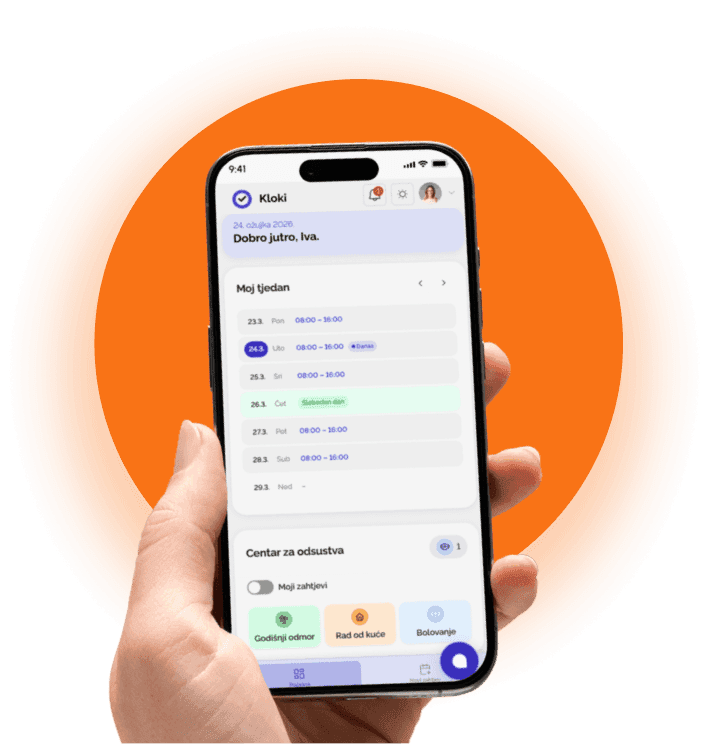
- An employee submits a PTO request through the app
- The manager gets a notification and clicks "Approve"
- The system automatically generates the decision with a digital signature — who approved it, when, and for what dates
- The document is verifiable — there's a QR code or hash that proves it's authentic
No printing. No scanning. No physical archive. No waiting for the manager to come back to their desk to sign a piece of paper.
And the most important part: if a year from now an auditor or a tribunal asks for proof that you approved that PTO — the document is there, with a timestamp and proof of who signed it. Try doing that with a paper form that might be in a drawer, might be in storage, or might have been thrown out with a stack of old papers.
For more on how this eliminates the "print–sign–scan" cycle: your employee says you approved their PTO. You don't remember. Now what?
How Kloki handles digital signatures
In Kloki, digital signatures aren't something you have to enable, configure, or pay extra for. They're built into every workflow.
QR seal with hash verification
Every document Kloki generates — PTO decisions, travel orders, overtime approvals — carries a QR seal. That seal contains a cryptographic hash that anyone can use to verify:
- Who signed — the name of the user who approved the document
- When it was signed — exact date and time
- Whether the document has been changed — hash verification flags any later modification
Anyone with the QR code can verify authenticity. An auditor, an accountant, an employee — they scan the QR and see that the document is original and unchanged.
Automatic signature on approval
The manager doesn't need to do anything extra. When they click "Approve" on a PTO request or a travel order, the system automatically generates the document with a digital signature. One click = a signed document, ready for the archive, an audit, or a court.
Digital archive
Every signed document is automatically kept in the digital archive. No folders, no shelves, no rummaging through drawers. When somebody asks for a PTO decision from two years ago, you find it in seconds.
Do you actually need a digital signature?
A simple test:
Yes, you probably do if:
- You have 5 or more employees and you're signing HR documents (PTO, travel orders, decisions)
- You spend more than 2 hours a month on the print–sign–scan–archive cycle
- You want to be audit-ready without hunting through drawers for paper
- You want your employees to stop waiting days for a signature because the manager is on the road
You probably don't if:
- You're a solo founder with no employees — there are no HR documents to sign
- You have 1–2 employees and generate fewer than 5 HR documents per year — paper is still fine
Anyone in between: a digital signature saves time, reduces risk, and keeps you ready for inspection at any moment. The question isn't whether you'll move to digital — it's how much longer you'll keep wasting time at the printer.
Digital signatures aren't the future — they're already the present
Ten years ago, sending an invoice by email instead of by post sounded radical. Today it's just how it's done. Digital signatures on HR documents are on the same path — legal, simple to use, and practical from day one.
You don't need to be an IT specialist. You don't need a qualified certificate for internal HR documents. You don't need to overhaul the way your business runs. You just need a system that handles cryptography, timestamps, and the archive for you.
Try Kloki for free and see for yourself how much simpler digital signing is than it sounds.